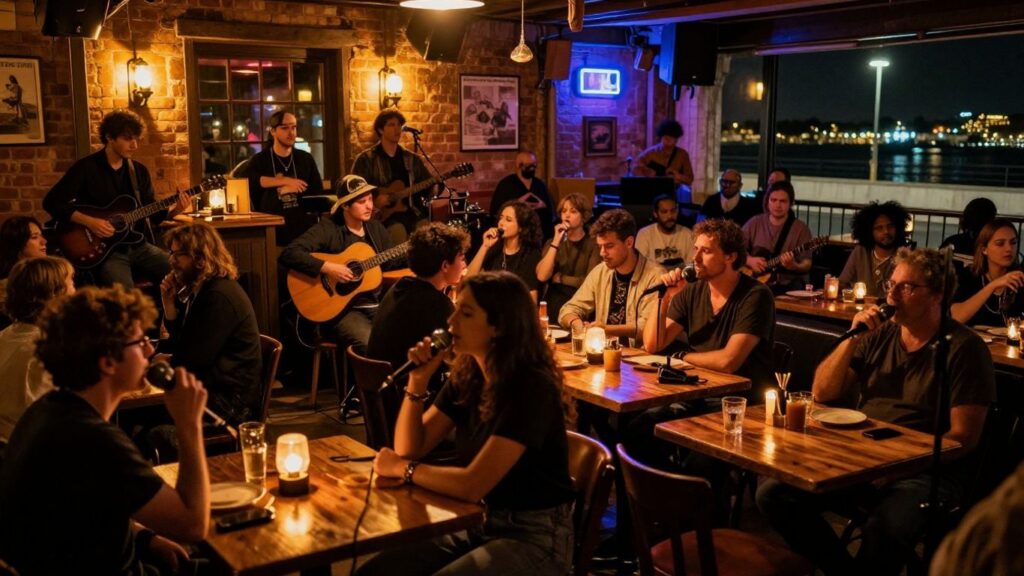
10 best live music pubs for a night worth missing your train
Key Takeaways
I’ve chosen these venues for the particular kind of night that makes a timetable feel more like a suggestion than a plan. Each has its own mood, musical history and reason to linger.
- Austin’s Continental Club brings old-school character and a close view of the stage.
- The Troubadour and the Fillmore pair live music with serious venue history.
- The Cavern Club and Bluebird Café are intimate rooms where the setting is part of the story.
- Charleston, Galveston and Washington, D.C. offer distinct local flavours beyond the obvious touring circuit.
- New York’s Bitter End and Bowery Ballroom prove that a memorable night can come in very different sizes.
1. The Continental Club — Austin, Texas
Austin has never needed much encouragement to turn an ordinary evening into a musical detour. On South Congress Avenue, the Continental Club feels like one of the city’s most convincing arguments for staying out late. I like it because the room has character without seeming to ask for admiration.
The appeal is the closeness of the experience. You are not watching a distant spectacle from a numbered seat; you are in a compact club where the band, the crowd and the clink of glasses occupy the same small patch of night. The programming has long been associated with roots, rockabilly, blues and country, so I arrive ready for musicians who understand that a song should move before it tries to impress.
There is pleasure in the lack of ceremony. I can walk in with modest expectations, find a place near the action and discover that the evening has acquired a pulse of its own. That is the Continental Club at its best: a room where the stage feels close and missing the next train seems like a reasonable professional decision.
2. The Troubadour — Los Angeles, California
The Troubadour is one of those Los Angeles rooms where the walls seem to have excellent musical memory. It has hosted generations of artists and remains closely associated with the city’s live scene. I find its appeal less about nostalgia than about the sense that a small stage can still alter a career, or at least a listener’s evening.
The room suits people who want to see performers properly rather than admire them from a great distance. A good night here has a certain concentration: the audience turns towards the stage, the songs do the heavy lifting, and the surrounding Los Angeles noise briefly loses its argument. Even a familiar act can feel newly urgent in a venue with this much accumulated atmosphere.
I would make time for a drink before the set and resist the temptation to over-plan the rest of the night. The Troubadour rewards attention, not frantic venue-hopping. Once the music starts, the best itinerary is often the one that quietly disappears.
3. The Bitter End — New York, New York
Greenwich Village has always made room for music that is still finding its shape, and The Bitter End belongs to that tradition. The club is known as a small, storied venue where emerging and established performers can share a close audience. I like the democratic feeling of it: the room does not need to be enormous to make a performance matter.
A night here can feel slightly unfinished in the best possible way. You may arrive for one name and leave remembering someone else from the bill, perhaps an artist who had only a handful of songs but delivered them with unnerving confidence. The setting encourages discovery because the distance between listener and performer remains pleasingly narrow.
New York offers plenty of places to be seen, but The Bitter End is better suited to being present. I would go with curiosity, leave a little space in the schedule and accept that the most interesting set may not be the one I expected. That is a useful arrangement for any night out.
4. The Cavern Club — Liverpool, England
The Cavern Club is inseparable from Liverpool’s musical identity, and its history gives the venue an unusual gravity. It is famous for its connection with The Beatles and for the role it played in the city’s early rock scene. Still, I would not treat it as a museum with a band attached; the point is that live music continues to animate the place.
The underground setting helps explain the club’s enduring atmosphere. Brick, low ceilings and close quarters create the feeling of a room built for songs rather than grand entrances. When the band is in full swing, the history becomes less like a plaque on a wall and more like a pressure in the air.
I would visit with enough time to let the room reveal itself rather than rushing in for a single photograph. Liverpool’s musical story is too lively to be reduced to one famous chapter. At the Cavern, the past is present, but it still has to share the stage with whoever is playing tonight.
5. The Pour House — Charleston, South Carolina
Charleston is often praised for its architecture, food and beautifully mannered streets, but The Pour House supplies a welcome change of volume. The venue is known for live music in a relaxed setting, with a calendar that can move between local performers and touring acts. I appreciate a place that allows a city’s evening to become louder without losing its sense of welcome.
The experience is refreshingly unceremonious. People arrive ready to listen, talk, move around and settle into the night at their own pace. Depending on the bill, the room can feel rootsy, rhythmic or full of guitar-driven energy, which makes checking the programme part of the fun rather than an administrative chore.
I would make this a destination rather than a hurried stop between dinner reservations. The Pour House works when the music gets enough room to breathe and the audience gives itself permission to stay. Charleston has plenty of polished pleasures; this one is more comfortable with a scuffed boot and a raised amplifier.
6. The Bluebird Café — Nashville, Tennessee
The Bluebird Café is famous for its intimate songwriter rounds, a format that places the writing itself close to the centre of the evening. Instead of relying on a large production, performers share songs and stories in a small listening room. I find that restraint unusually compelling, particularly in a city where the music industry can otherwise feel very large.
The room asks for attention in a gentle but unmistakable way. Conversations soften, songs arrive without much ornament and a line that might pass unnoticed in a crowded bar can suddenly land with precision. It is a setting for hearing how a song began, changed and found its way into the world.
This is not the place I would choose for a noisy reunion or a loose plan to wander in whenever I fancy. I would check the arrangements, arrive prepared to listen and let the songs set the pace. The reward is a kind of musical intimacy that stays with me longer than a louder night often does.
7. The 9:30 Club — Washington, D.C.
Washington, D.C.’s 9:30 Club has earned its reputation as a serious live venue without becoming solemn about it. The club presents a broad range of touring and local acts, and its room can accommodate the charged anticipation that comes with a busy calendar. I like venues that trust the audience to follow the music across genres.
The atmosphere is energetic but not needlessly theatrical. A crowd can gather around a rising act, a well-loved band or a performer making an unexpected turn, and the room gives each kind of night enough space to develop. There is a satisfying sense that the event belongs to the people inside it rather than to a grand idea of what a concert should be.
I would arrive with comfortable shoes and a willingness to surrender the evening’s neat edges. The 9:30 Club is best experienced at the pace of a proper gig: queue, support act, main set, one more song, and a walk back through the city while the last chorus is still in my head. Public transport timetables may disagree, naturally.
8. The Fillmore — San Francisco, California
The Fillmore is one of San Francisco’s landmark music venues, with a history tied to the city’s influential concert culture. Its name carries associations with psychedelic rock and the broader flowering of live music in the 1960s. I enjoy the way the venue treats that heritage as a living backdrop rather than a reason to stop changing.
The room’s personality is part of the visit. Decorative details, posters and the close relationship between the audience and stage create an atmosphere that feels more personal than a standard concert hall. There is enough history to make the walls interesting, but the current performance still has to win the night.
I would choose a show here when I want the venue and the act to converse with each other. The Fillmore can make a familiar touring format feel more textured, particularly when the crowd is fully engaged. Leave with a poster if you like, but the better souvenir is the moment when the room suddenly sounds larger than its walls.
9. The Old Quarter Acoustic Café — Galveston, Texas
The Old Quarter Acoustic Café offers a quieter kind of live music experience in Galveston. Its focus on acoustic performance creates a useful contrast with the larger, louder rooms on this list. I like arriving somewhere that makes a listener notice phrasing, pauses and the small mechanics of a song.
The café’s setting suits performers who can hold attention without hiding behind volume. Folk, roots, blues and singer-songwriter material can take on extra weight when the arrangement is spare and the room is listening. It is the sort of place where a modest gesture—a change in picking pattern, a dry aside, a breath before a verse—can become part of the evening’s texture.
I would pair a visit with a slow wander through Galveston rather than trying to cram it into a packed schedule. The Old Quarter Acoustic Café is a reminder that a memorable music night does not need spectacle. Sometimes the train is worth missing because one well-told song has made the clock less persuasive.
10. The Bowery Ballroom — New York, New York
The Bowery Ballroom brings a polished but intimate finish to this list. Its reputation rests on a strong live calendar and a room that can make a developing act feel important without making the audience feel remote. I have always liked venues where the architecture supports the performance instead of competing with it.
The balcony and compact floor create a satisfying sense of occasion, particularly when the crowd has arrived early for an artist on the way up. New York’s music scene can be overwhelming in its range, so a venue with a reliably focused atmosphere is a gift. The Bowery Ballroom lets the night feel substantial while keeping the human scale intact.
I would leave the final decision to the bill and then give the show my full evening. There is no need to chase three more rooms after a set that has done its job. Walk out into the Bowery, hear the city resume its argument and decide whether the last train was ever really the point.
Conclusion
The best live music pubs and clubs are not interchangeable stops on a map; they are rooms with distinct habits, histories and kinds of attention. I would choose one according to the night I want—rowdy, intimate, exploratory or quietly absorbing—and then leave enough time for the music to make its own plans.
Frequently Asked Questions
What makes a live music pub worth visiting?
A worthwhile venue usually combines an engaging performer, a room that suits the music and an atmosphere that makes staying feel natural. The best choice depends on whether I want discovery, history, intimacy or a louder communal night.
Should I book live music venues in advance?
For popular rooms and limited-capacity songwriter nights, advance planning is sensible. Smaller local gigs may be more flexible, but I still check the venue’s schedule, entry arrangements and expected start time before setting off.
Are intimate venues better than large concert halls?
Neither is automatically better. Intimate venues can make a performance feel immediate, while larger rooms create space for bigger production and a more collective sense of occasion.
What should I bring to a live music pub?
I usually bring only the essentials: comfortable shoes, a charged phone and enough patience to let the evening run late. Checking the venue’s entry rules is more useful than arriving with a heroic amount of luggage.
How early should I arrive for a gig?
I arrive earlier when I want a good view, when the venue is standing-room only or when there is a support act I do not want to miss. For a seated or reserved event, the timing can be more relaxed, but I still allow room for queues.
Can I visit these venues alone?
Yes. Going alone can make it easier to focus on the music and meet other listeners without coordinating a group. I choose a venue with an atmosphere that feels comfortable and make sensible arrangements for getting home.
How do I find new live music while travelling?
I check the venue’s official calendar, local listings and nearby record shops or cafés for recommendations. A flexible evening helps; some of my favourite discoveries have come from choosing a support act or a small local bill rather than chasing only familiar names.